BGPVerse — Interactive Map of the Internet
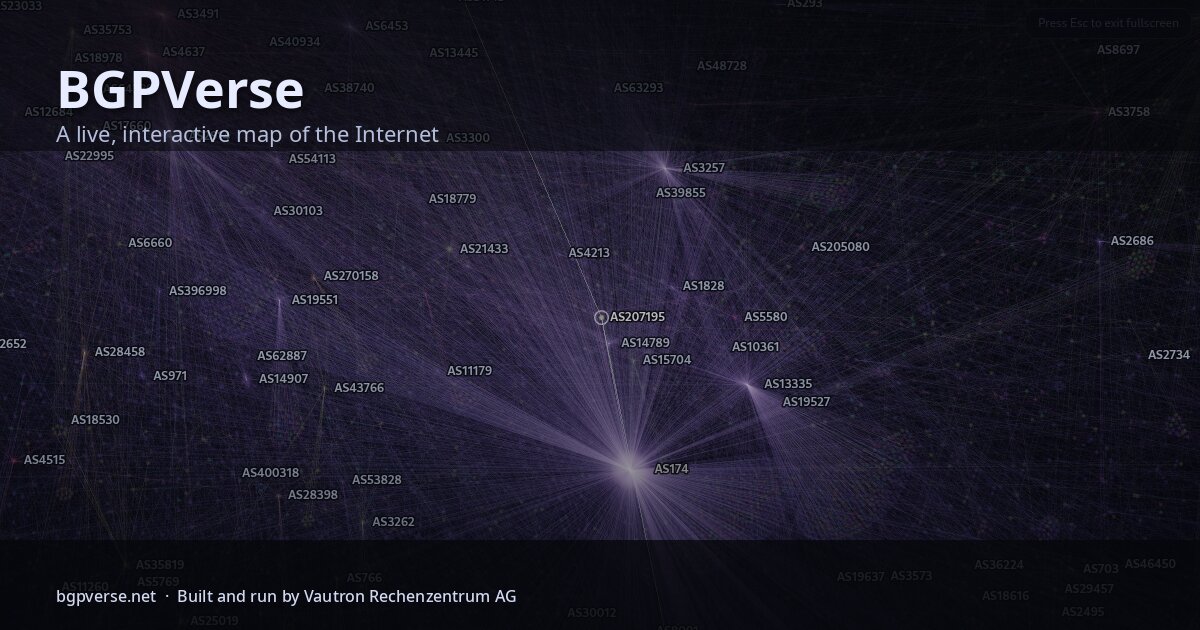
BGPVerse is a live, interactive map of the Internet: autonomous systems (ASes) and their BGP routing connections, rendered from RIPE NCC's Routing Information Service (RIS) data.
The map itself is an interactive WebGL application. Here is what it shows, in short:
Please enable JavaScript to use the interactive map. Operated by Vautron Rechenzentrum AG.
Take a short, animated flight across the Internet's backbone networks before diving in — or skip straight to exploring the map yourself.
Every dot on this map is an Autonomous System (AS): a network, or group of networks, run by one organisation — an internet provider, a university, a cloud provider, a company's own network — that has its own block of IP addresses and decides, as a single unit, how traffic enters and leaves it. An AS is not a building, a single computer, or even a single physical place: one AS can be one rack in a data centre, or the entire network of a nationwide internet provider.
An AS itself is not a computer, it is a boundary. Inside it there can be a handful of servers, or millions of laptops, phones, routers, smart-home gadgets and websites, none of which are visible on this map. A large internet provider's AS, for example, stands for every one of its customers' home routers and everything behind them — but it is still just one dot here, the same size category as a single small company's network.
The lines between dots are not physical cables; they are observed routing relationships. The Internet has no central map of itself. Instead, each AS tells its neighbours, using a protocol called BGP (Border Gateway Protocol), which IP address ranges ("prefixes") it can reach and through which path. By collecting what thousands of networks announce to each other (via RIPE NCC's Routing Information Service, see the Credits dialog), this map reconstructs which ASes are, in practice, directly connected to each other.
In a little more detail: BGP is how networks exchange reachability information with each other at Internet scale — it has run the Internet's routing since the early 1990s, is deliberately simple (each router only ever tells its neighbours what it knows, not the whole Internet's topology at once), and is also why a single misconfigured announcement somewhere can, in principle, affect routing far away ("leaks"/"hijacks"). For the full protocol details, see BGP on Wikipedia.
BGPVerse visualises this AS-level topology: which networks exist, roughly how large they are (by number of IP prefixes and neighbours), which country they are registered in, and which other networks they are talking to right now in the live BGP feed. It does not show individual IP addresses, physical cables or data centres, or real-time traffic volume — only who is connected to whom, as seen through Internet routing.
The short, comet-like lines that dart across the map (when the Live view is on) are individual, real-time BGP route announcements and withdrawals as RIPE's route collectors observe them, seconds after the fact. Each flash is a single routing-table change between two ASes — not a data packet, a request or "live traffic" in the usual sense, just one update to who-can-reach-whom. A burst of flashes around one AS over a short time is usually routine (maintenance, a session reset, traffic engineering); occasionally it marks an anomaly candidate (see the glossary below), which is a hint worth a second look, not proof of a problem.
A red, dashed line is a different, more specific signal: it marks an anomaly candidate, connecting the AS that just announced a prefix to the AS the snapshot expected to originate it instead. It means "this announcement looks unusual compared to what we knew before", not that an attack or outage is definitely happening — see the log (More menu, when Live is on) for the details behind any particular flash.
Anomaly detection above only compares against what this snapshot has seen before; it has no way to tell whether an announcement was ever actually authorised. RPKI (Resource Public Key Infrastructure) is the Internet's cryptographic answer to that: the holder of a prefix can publish a signed ROA (Route Origin Authorization) stating exactly which AS is allowed to originate it, and up to which prefix length. When the server is configured with a local Routinator instance (see Credits), the AS panel's prefix list shows a small badge next to each one:
No badge at all (rather than one saying "unknown") means either RPKI validation is not configured on this server, or Routinator could not be reached for that particular lookup.
BGPVerse is built entirely from data published by RIPE NCC's Routing Information Service (RIS): route collectors at Internet exchange points around the world record the BGP announcements their connected networks send them. The map itself is a periodically refreshed snapshot of a full routing table; with the Live view on, it additionally follows RIPE's RIS Live real-time feed for the flashes described above. See the Credits dialog (footer) for full attribution, data-quality notes and licensing.
This snapshot combines several of RIS's route collectors for better coverage and evidence (a link seen by more than one is more trustworthy than one seen by just one):
Settings → "Show links seen by" can isolate a single collector's own view instead of this combined one, e.g. to see only what one specific vantage point observes.
192.0.2.0/24
203.0.113.0/25
203.0.113.0/24
This map is built and run by Vautron Rechenzentrum AG, a data centre and managed-hosting provider — see the Credits dialog for the full story, or just visit vautron.de if you are looking for servers, cloud or network services of your own.
Parts of this project, especially the frontend, were built with AI assistance. Questions or feedback about the project? Write to noc@vautron.de.
The link restores the view, projection, selection, path and filters.
The long link above works forever on its own (nothing is sent to the server). "Create short link" is optional and asks the server to remember this view under a short id instead — best-effort only, it may stop working after a server restart or once very old.
Whether BGPVerse's own background data pipeline is currently up to date — not just whether the server itself is reachable. Also available as its own page/JSON endpoint: /status.
A simplified simulation: for a sample of this AS's direct neighbours, compares how many hops away a well-connected reference backbone AS is, with and without this AS in the graph. It only counts hops over currently visible links, with no real BGP policy, business relationship, or path-preference modelling — a rough indicator of structural centrality in this snapshot, not a prediction of what would actually happen if this AS went offline.
Links seen by a single collector peer can be path poisoning or leaks. The filter applies to the map, the path finder and the neighbour lists.
Isolates a single RIS collector's view instead of the combined one; a link not seen by that collector is hidden everywhere the peer filter above applies too. See Help for what each collector is.
Hides every link outright that is not the chosen BGPKIT as2rel relationship type (most links have no relationship data at all and are hidden too, except with “All relationships”) — useful at a close zoom, where the sheer number of links on screen can otherwise make individual connections hard to follow.
Stored only in this browser.
Vautron Rechenzentrum AG Obermünsterstr. 9 93047 Regensburg
Eingetragen beim Amtsgericht Regensburg, HRB 13461 USt-ID: DE 221 561 770
Telefon: +49 (0)941 5990-0 Telefax: +49 (0)941 59909-0 E-Mail: info@vautron.de
Vorstand: Martin Kluge, Robert Spandl Aufsichtsrat (Vorsitz): Franz Fleischmann
Inhaltlich verantwortlich (§ 18 Abs. 2 MStV): Vautron Rechenzentrum AG, Anschrift wie oben. Telefon: +49 (0)941 5990-680 E-Mail: info@vautron.de
Abuse-Meldungen: abuse@vautron.de
Lizenz: Diese Website und ihre Inhalte (Quellcode, Dokumentation, Konfiguration sowie abgeleitete Daten wie der von diesem Projekt bereitgestellte AS-Topologie-Snapshot) sind urheberrechtlich geschützt. Es wird keine Lizenz zur Kopie, Veränderung, Veröffentlichung, Verbreitung oder zum Verkauf dieser Software oder ihrer Ausgabe eingeräumt, weder vollständig noch in Teilen, ohne vorherige schriftliche Zustimmung der Vautron Rechenzentrum AG. Vollständiger Lizenztext: bgpverse.net/license.txt.
This is a courtesy translation for international visitors. The German version above is the legally authoritative one (as required for a German company's Impressum).
Vautron Rechenzentrum AG Obermünsterstr. 9 93047 Regensburg, Germany
Registered with the Regensburg local court (Amtsgericht Regensburg), commercial register no. HRB 13461 VAT ID: DE 221 561 770
Phone: +49 (0)941 5990-0 Fax: +49 (0)941 59909-0 Email: info@vautron.de
Managing Board: Martin Kluge, Robert Spandl Supervisory Board (Chair): Franz Fleischmann
Responsible for editorial content (per § 18 para. 2 of the German Interstate Media Treaty, MStV): Vautron Rechenzentrum AG, address as above. Phone: +49 (0)941 5990-680 Email: info@vautron.de
Abuse reports: abuse@vautron.de
License: this website and its contents (source code, documentation, configuration, and derived data such as the AS-topology snapshot served by this project) are proprietary. No license is granted to copy, modify, publish, distribute, or sell copies of this software or its output, in whole or in part, without the prior written permission of Vautron Rechenzentrum AG. Full license text: bgpverse.net/license.txt.
BGPVerse sets no cookies and uses no analytics, advertising or third-party trackers of any kind.
Your browser stores only your own display settings (pulse duration, log rows, colour mode, etc.) in localStorage under the key bgpverse-settings, plus whether you have dismissed this notice. Nothing is transmitted to a server because of this storage; it is technically necessary for the feature you are using and requires no consent under applicable ePrivacy rules.
localStorage
bgpverse-settings
Server-side, your IP address is used only transiently (in memory, never written to disk beyond a request-path access log line without the query itself) for rate limiting and the "My IP" feature; see the Credits & data sources dialog for where the map data itself comes from.
BGPVerse is built and run by Vautron Rechenzentrum AG, a data centre and managed-hosting provider based in Regensburg, Germany — this map is one of our side projects, not a product.
Looking for servers, cloud or network services of your own? Visit vautron.de →
“The RIPE Routing Information Service (RIS) is a RIPE NCC service. With the help of network operators all over the world, RIS employs a globally distributed set of Remote Route Collectors (RRCs), typically located at Internet Exchange Points, to collect and store Internet routing data. Volunteers peer with the RRCs using the BGP protocol and RIS stores the update and withdraw messages. RIS data can be accessed via: RIPEstat, the “one-stop shop” for all available information about Internet number resources. RIPEstat uses individual widgets to display routing and other information; RIS Live, a real time BGP streaming API allowing server-side filtering of BGP messages by prefix or autonomous system; RIS Raw Data, available for each route collector, with state dumps and batches of updates made available periodically; RISwhois, that searches the latest RIS data for details of an IP address using a plaintext “whois”-style interface. It is useful when querying RIS data using scripts.”
RIPE RIS's own route collectors sit mostly at European/major Internet exchange points, so this map's view is naturally strongest there. RouteViews (University of Oregon) route collector data fills in several collectors RIS itself has few or none near — Nairobi (KIXP), Johannesburg (NAPAfrica), São Paulo (IX.br), Bangkok (BKNIX) and Hong Kong (HKIX) — for a somewhat broader (though still inevitably incomplete) view of the Internet's edges. With contributions from network operators and volunteers all over the world, RouteViews collects BGP data by direct peering at Internet Exchange Points (IXPs) or multi-hop peering. Data are archived and made publicly available for download at archive.routeviews.org, lg.routeviews.org, and api.routeviews.org. Used under its CC BY 4.0 licence.
AS names and registration countries: RIPE NCC AS names list. Approximate AS locations shown on the Geo and Globe views: IP Geolocation by DB-IP (DB-IP City Lite, refreshed daily, derived from a sample of each AS's announced prefixes — not the AS's actual location). AS relationships (upstream provider / peer / downstream customer, shown on each AS's own page, e.g. /as/3356, and optionally as a map colour overlay via Settings → “Colour links by” → “AS relationship”) are an inference, not ground truth, from BGPKIT's free as2rel dataset, refreshed daily. Land outline: Natural Earth 1:50m land polygons (public domain). Icons: a small selection from Font Awesome Free (CC BY 4.0), self-hosted, not loaded from a CDN.
/as/3356
RPKI route-origin validity badges (AS panel → prefix list), when enabled by the operator, are computed by a self-hosted Routinator instance (NLnet Labs, BSD-3-Clause), which fetches and validates Route Origin Authorizations (ROAs) directly from the public RPKI repositories of the five Regional Internet Registries. See the Help dialog for what the badges mean.
This site stores only your display settings in your browser — no cookies, no tracking, no third parties.